
Humanities
Reading the World. Shaping the Future.
The Humanities at JCHS prepare students to think critically, communicate clearly, and engage thoughtfully with the world around them. Through literature, history, writing, and discussion, students learn to analyze complex ideas, evaluate evidence, consider multiple perspectives, and present well-supported arguments.
Our curriculum combines rigorous reading and writing with meaningful collaboration and interdisciplinary learning. Students explore diverse voices, cultures, and historical experiences while strengthening the skills they'll use throughout college, careers, and civic life.
Two Disciplines.
One Conversation.
English
Students engage with novels, plays, poetry, essays, memoirs, journalism, and other forms of writing that challenge them to think deeply about language, culture, and the human experience. Through analytical, persuasive, and creative writing, they develop the ability to communicate with clarity, confidence, and purpose.
History
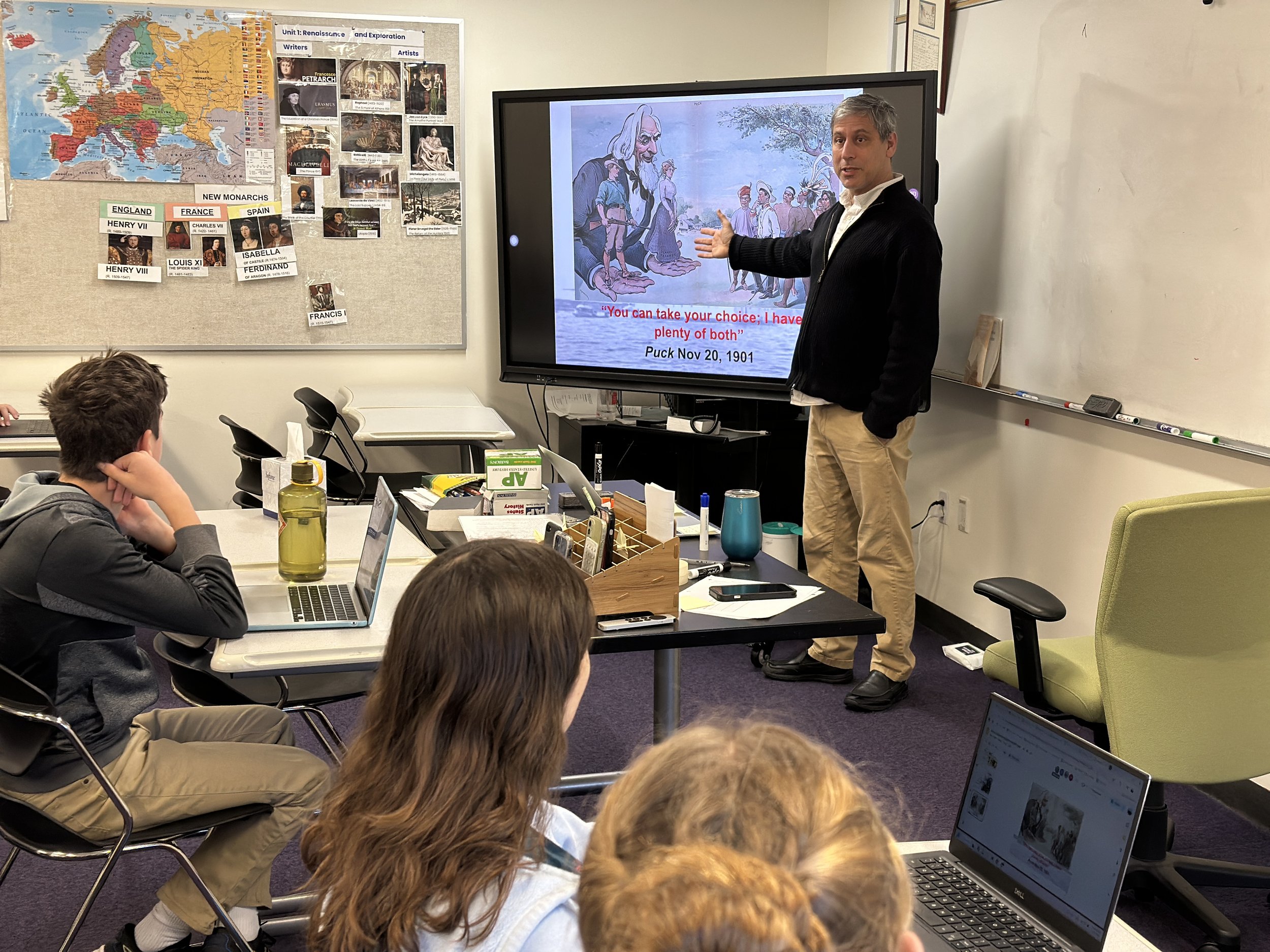
History courses encourage students to investigate the past through primary sources, multiple perspectives, and historical inquiry. Students develop the skills to evaluate evidence, recognize patterns, understand historical context, and make meaningful connections between the past and today's world.
Many Humanities courses are intentionally integrated, allowing students to connect literature, history, ethics, and current events through shared projects and interdisciplinary learning experiences.
Humanities Graduation Requirements
English
4 years of core English
History
2 years of core History
Humanities Elective
1 elective course
Ninth graders begin with Postcolonial World English, followed by American Literature in tenth grade. Eleventh and twelfth grade students choose from grade-specific English options. Students complete United States History in tenth grade and Modern Jewish History in eleventh grade.
Explore Humanities Courses
ENGLISH CORE COURSES
-
Subject Area: English
Open to: 9In English 9, students develop a rich foundation for the study of world literature, with an emphasis on non-western literature. They encounter a range of engaging texts that cross genres and cultures, including texts from Asia and the Caribbean. These texts include the Shakespeare play The Tempest, the graphic novel Persepolis, the Korean and Japanese set multigenerational saga Pachinko, and the multi-perspective Haitian novel The Dew Breaker, among others. As they study contemporary world literature, students refine their critical reading abilities by learning to recognize textual patterns and analyze writers’ choices. This allows students to challenge normative assumptions by engaging with non-Western experiences while learning to identify and explain the historical and cultural structures and systems that have impacted social inequality. Throughout the course, students will build their composition skills, including crafting clear arguments and using evidence effectively. Students culminate their year by participating in a mock trial where a character from The Dew Breaker is put on trial, with students arguing as the defense or the prosecution. While the emphasis will be on analytical writing, students will also have the opportunity to work on creative projects, such as visual representations of characters and themes, as well as a “choose your own adventure” project where students can create art pieces, playlists, or write their own short stories.
-
Subject Area: English, American Studies
Open to: 10In this course, students will study American Literature from the Colonial period through the 20th century. Over the course of the year, students will read and analyze texts ranging from Native American literature to fugitive slave narratives by Frederick Douglass, to influential American novels like F. Scott Fitzgerald’s The Great Gatsby. We also explore short fiction that thematizes women’s struggle for societal reforms at the end of the 19th century, including “The Yellow Wallpaper” by Charlotte Perkins Gilman, and learn to analyze poetry through close study of Emily Dickinson and Langston Hughes. Students will build on their knowledge of literary genre and form, and deepen their analytical writing abilities by writing frequent argumentative essays which go through extensive drafting and revision. Several units will be taught in coordination with U.S. History and AP U.S. History, enabling students to learn about literature with a richer sense of historical context. The final project of the year brings together American Literature and US History curricula by staging a mock school board meeting. Students take on the role of a parent, student, or teacher to argue for or against the inclusion of controversial texts in the JCHS curriculum.
-
Subject Area: English
Open to: 11This writing-intensive course provides juniors with the tools to become more confident, proficient, and creative academic writers. Students will work on a variety of writing assignments in a range of genres, all designed to help them cultivate their ability to make and support persuasive arguments. From deconstructing opposing arguments, to writing their own op-eds, magazine features, and book reviews, students will be able to move beyond the five-paragraph essay and engage in meaningful, real-world analytical writing formats. Readings will include essays and features about key debates in contemporary culture, Chanel Miller’s Know My Name, and the classic novel Frankenstein. In conjunction with their Biology class, students will prepare for reading Frankenstein by writing a research paper that explores the ethical ramifications of creating human life. Students will also study the elements of the personal essay in the second semester, and cultivate their own writing style as they work on crafting their college essays. Over the course of the year, students will compose a minimum of six pieces, all of which will go through an extensive drafting and revision process.
-
Subject Area: English
Open to: 11
Prerequisite: B+ in American LiteratureThe AP English Language and Composition course focuses on the development and revision of evidence-based analytic and argumentative writing and the rhetorical analysis of both fiction and nonfiction texts, from writers such as Abraham Lincoln, Frederick Douglass, Matther Desmond, Martin Luther King Jr., Cesar Chavez, and Ta-Nehisi Coates. Through frequent writing assignments, students evaluate, synthesize, and cite research to support their arguments. Additionally, they read and analyze rhetorical elements and their effects in nonfiction texts from a range of disciplines and historical periods. Students will read various non-fiction texts—from newspaper editorials to philosophy, to literary non-fiction, to memoirs, to speeches—all to discover how an author crafts an argument. In conjunction with their biology class, students will prepare to read Mary Shelley’s Frankenstein by writing a research paper that explores the ethical ramifications of creating human life. Students will also study the elements of the personal essay in the second semester and cultivate their writing style as they craft their college essays. Advancing their mastery of all aspects of powerful composition, students will be challenged to develop a more versatile and bold writing style, learning to adapt their writing voices to meet the demands of genre, audience, and occasion.
-
Subject Area: English
Open to: 12This class will delve into one of the most relevant topics in today’s world: the environmental crisis and climate change. The central question of the course is this: what is the relationship between how we depict and represent nature and how we treat nature in “real life?” How we represent nature in art, literature, or film partly explains how we use, extract, manipulate, or preserve nature. Our course will explore, among others, the idea of nature as a cultural construct, representations of plants as vengeful entities, our complex relationship with animals, and the anxiety (and hopeful promise) of environmental disasters. Ultimately, we will understand how culture should be a fundamental part of the ecological equation and reflect on the ethical and political debates around our environmental approach. To do this, we will explore literature, film, photography, and visual art, asking how each particular medium contributes to the question of nature. Some of the readings include Cormac McCarthy’s post-apocalyptic novel The Road, Steven Spielberg’s film adaptation of Jurassic Park, Sebastiao Salgado’s stunning and disturbing mining photographs, and Horacio Quiroga’s plant horror short stories.
This course is integrated with Senior Seminar: Issues in Jewish Thought. In both courses, students will explore common philosophical and ethical themes such as systemic oppression, the problem of evil, and the importance of memory. To that end, students will write a complex essay that involves integrating material from both classes in order to discuss how the abuse of power and systemic oppression manifest and impact individuals and society more widely.
-
Subject Area: English
Open to: 12
Prerequisite: B+ in Writing and Rhetoric or B in AP English Language and CompositionAs the title character, Sula, proclaims in Toni Morrison’s 1973 novel: “I don’t want to make somebody else. I want to make myself” (91). This course will explore narratives of self-fashioning in both fiction and poetry, and will pay special attention to moments of tension between individual desires and cultural norms. Through reading novels ranging from canonical 19th century texts like Gustave Flaubert’s Madame Bovary to modern classics like Zora Neale Hurston’s Their Eyes Were Watching God, students learn how to use close-reading techniques to build persuasive arguments about the ways writers use language and literary devices to create meaning. The study of poets ranging from Emily Dickinson to Terrance Hayes will equip students with an understanding of the subtle ways meaning can shift and evolve over the course of a short lyrical poem. In preparation for the Advanced Placement exam, students will become confident writing thesis-driven, tightly organized, analytical essays in a limited amount of time.
This course is integrated with Senior Seminar: Issues in Jewish Thought. In both courses, students will explore common philosophical and ethical themes such as systemic oppression, the problem of evil, and the importance of memory. To that end, students will write a complex essay that involves integrating material from both classes in order to discuss how the abuse of power and systemic oppression manifest and impact individuals and society more widely.
HISTORY CORE COURSES
-
Subject Area: History, American Studies
Open to: 10This survey course in United States history will examine the major historical forces and events which have shaped our country. Students will review both early and more contemporary American history and examine significant factors that continue to have relevance to our society. Students will learn to employ primary sources, secondary texts, and multimedia offerings to gain a profound understanding of American history and culture. The course will focus on developing students’ abilities to think critically, write clearly articulated and well-substantiated arguments, and develop the confidence and skills to participate in class discussions and debates. Students will finish the year by writing an integrated research paper in conjunction with their American Literature course, which will require students to utilize research skills, make clear connections between history and the present, and write cogently and convincingly. This course integrates with the American Literature course to develop a curriculum in which literature supports and reinforces studies in United States history.
-
Subject Area: History, American Studies
Open to: 10
Prerequisite: B+ in Postcolonial World LiteratureAP United States History is designed to be the equivalent of a two-semester introductory college or university United States history course. Students will investigate the content of U.S. History for significant events, individuals, developments, and processes and use and strengthen the same thinking skills and methods employed by historians when they study the past, including analysis of primary and secondary sources; application of historical comparisons, causation, and chronological reasoning; and the substantiation of arguments with pertinent evidence. The course is structured around seven themes (American and National Identity; Migration and Settlement; Politics and Power; Work, Exchange, and Technology; America in the World; Geography and the Environment; and Culture and Society) that students explore throughout the year in order to make connections among historical developments in different times and places. A premium will be placed on identifying and contextualizing modern day equivalents to historical events and developments. The emphasis of this course will be to help students develop clear, concise analytical essay writing skills.
-
Subject Area: History
Open to: 11What does being Jewish mean in the 21st century? How did we get here, and where can we go in the future? In this class, we will study how Judaism, Jewish identity, and Jewish politics changed in modernity to discover models for how we may craft a Jewish life in the 21st century.
We will explore: how Jews navigated the granting of rights and citizenship in emerging nation states, how Judaism evolved from traditional community-rooted practice to diverse modern theologies and denominations, and how Jews confronted the challenge of European nationalism - including the rise of Zionism and the establishment of the State of Israel. We will then explore the relationship of Jews to the modern idea of race - including the racialization of Jews in the Shoah (Holocaust) and the complex place of Jews in the American racial landscape. Students will have the opportunity to explore a topic of personal interest and strengthen their research, analysis, and writing skills through an independent research paper.
ELECTIVE COURSES
-
Subject Area: History
Open to: 11, 12The AP course in Comparative Government and Politics introduces students to fundamental concepts used by political scientists to study the processes and outcomes of politics in a variety of country settings. The course aims to illustrate the rich diversity of political life, to show examples of existing institutional systems, to explain differences in processes and policy outcomes, and to communicate to students the importance of global political and economic changes. Comparison assists both in identifying problems and in analyzing policy making. Additionally, the course covers the major concepts that are used to organize and interpret specific countries and their governments. Six countries form the core of the AP Comparative Government and Politics course: China, The UK, Iran, Mexico, Nigeria, and Russia. By using these six countries, the course can move the discussion of concepts from abstract definition to concrete example, noting that not all concepts will be equally useful in all country settings.
-
Subject Area: History
Open to: 11, 12The AP European History course focuses on developing students’ understanding of European history from approximately 1450 to the present. The course has students investigate the content of European history for significant events, individuals, developments, and processes in four historical periods, and develop and use the same thinking skills and methods (analyzing primary and secondary sources, making historical comparisons, chronological reasoning, and argumentation) employed by historians when they study the past. The course also provides five themes (interaction of Europe and the world; poverty and prosperity; objective knowledge and subjective visions; states and other institutions of power; and individual and society) that students explore throughout the year in order to make connections among historical developments in different times and places.
-
Subject Area: English
Open to: 10, 11, 12Stories help us understand ourselves and make sense of the world around us. In this course, students explore the elements of compelling storytelling across a variety of forms and media.
Through short fiction, creative nonfiction, journalism, photographic essays, and multimedia storytelling, students experiment with voice, structure, character, and perspective while developing their ability to craft engaging narratives for different audiences and purposes.
-
Subject Area: Jewish History
Open to: 11, 12
Cross-listed with: Jewish StudiesThe Holocaust watershed event that defines the course of modern Jewish history, and modern history itself. In this first half of this course, students will explore the history of the Holocaust. Topics will include pre-war Jewish life, the rise of Nazism, the evolution of Nazi policy toward Jews, and the development of the final solution. The second half of this course will focus on the legacies of the Holocaust, including: survivors and generational trauma, post-Holocaust theology, the invention of the concept of “genocide” and its application to international human rights, the use of Holocaust imagery in political discourse, and the complexity of representing and memorializing the Holocaust in art and media.
Please Note: As a cross-listed course, students may choose to count this course towards either their Jewish Studies or Humanities elective graduation requirement.
-
Subject Area: History
Open to: 11, 12
Cross-listed with: Jewish StudiesThe history of the Israeli-Palestinian conflict is shaped by competing experiences, narratives, and interpretations. This course helps students understand the historical turning points and perspectives that have contributed to the conflict and continue to influence political positions today.
Through historical study and dialogue, students examine the core issues underlying the conflict, the experiences of different populations in the region, and a wide range of perspectives informing contemporary discourse. The course emphasizes open-hearted engagement, thoughtful dialogue, and an appreciation for complexity.
Please Note: Students may count this cross-listed course toward either their Jewish Studies or Humanities elective graduation requirement.
-
Subject Area: History
Open to: 9In this world history course, students will discover the pulse of major societal developments and unravel the intricate web of interconnectivity that defines our contemporary world. From the origins of our species in Africa, the emergence of complex societies in Ancient Mesopotamia and Egypt, to the formation of powerful states across the globe, we will consider the forces that have shaped history. Each unit will explore concepts and case studies from the past while drawing valuable parallels to the present. To navigate these complex narratives you will engage in a dynamic adventure where you’ll build essential skills like active reading, research, and critical thinking and writing skills.
Please Note: This is an introductory course open to all 9th graders, which may be taken in lieu of Foundations of Computer Science.
Why the Humanities Matter
Hear from Dr. Camilo Jaramillo, Dean of Humanities, about how the study of literature, history, and culture helps students think critically, explore different perspectives, and find meaning in their learning.
JCHS is grateful for the generous support of our Theater Arts & Humanities sponsor.