
Jewish Studies
Ask Questions.
FIND MEANING.
At JCHS, Jewish Studies invites students to engage with thousands of years of Jewish wisdom, values, thought, and culture in order to explore questions that matter in their own lives today.
Through close reading, discussion, collaboration, and critical inquiry, students encounter multiple perspectives and develop the skills to interpret complex texts, articulate their ideas, and listen thoughtfully to others. Along the way, students build Jewish literacy while developing their own identities and connections to Jewish tradition.
With courses spanning Bible, Rabbinic Literature, History, and Culture, students can explore Jewish tradition broadly or pursue particular areas of study in greater depth.
Learning Through Chevruta
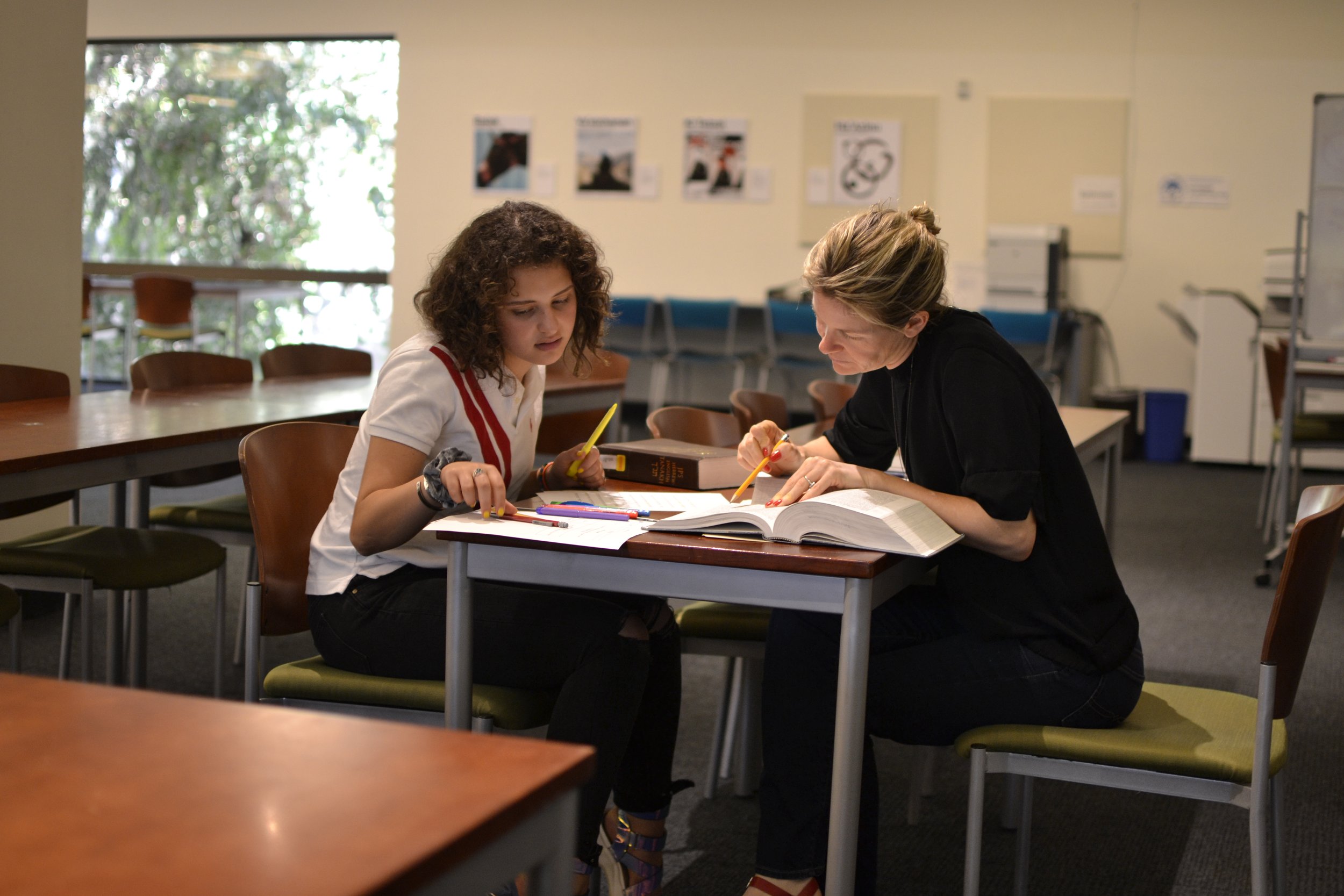
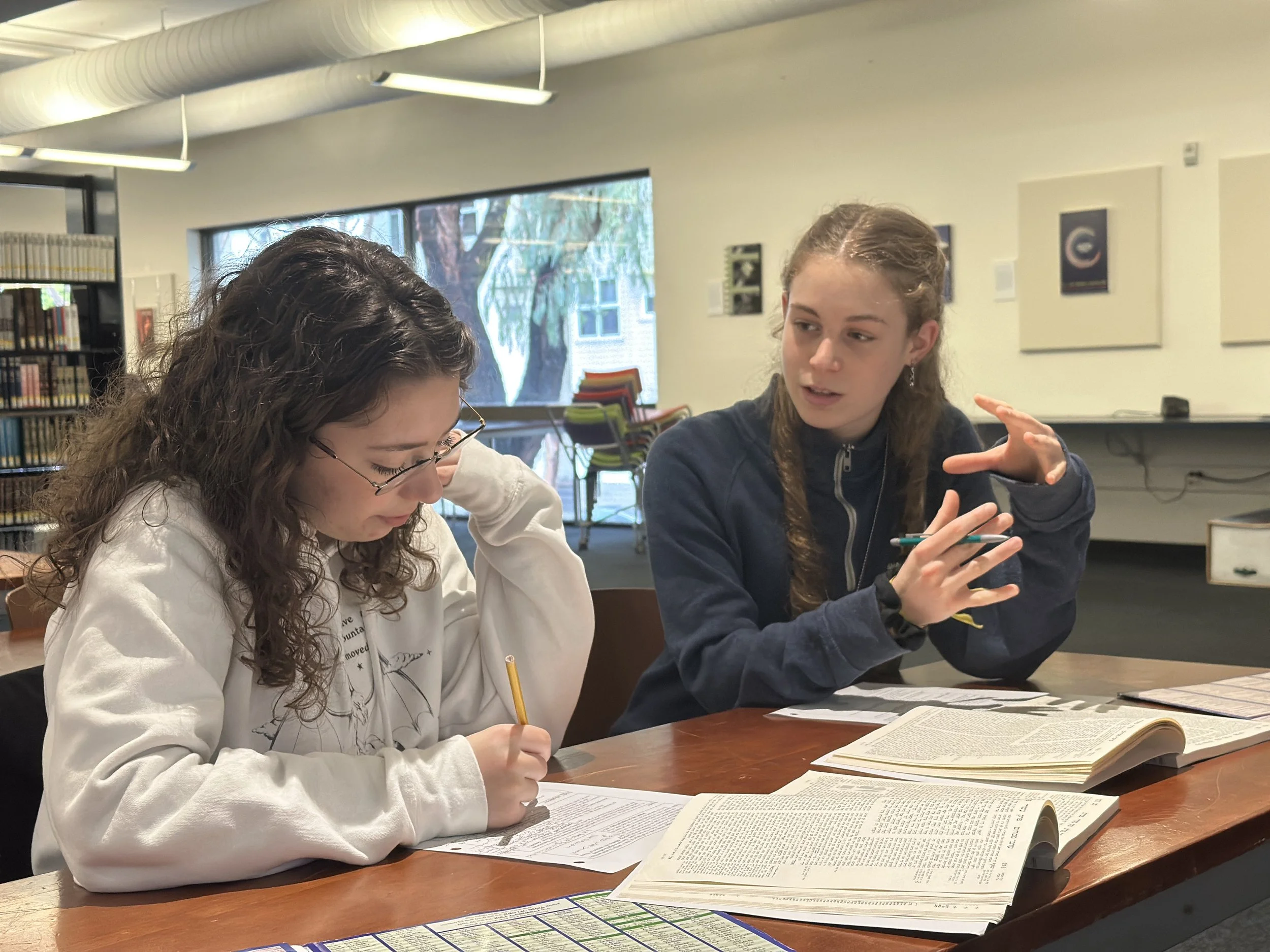
Chevruta, a traditional Jewish approach to learning, pairs students together to study, question, interpret, and discuss Jewish texts.
Rather than simply receiving answers, students learn to articulate their own interpretations, listen carefully to another point of view, challenge one another's thinking, and refine their ideas through conversation. By engaging with texts and commentaries that span centuries and represent differing perspectives, students learn that thoughtful disagreement can deepen understanding.
These skills extend far beyond Jewish Studies, preparing students to engage thoughtfully with different ideas and perspectives in an increasingly complex world.
Four Areas of Study
Students are placed in Jewish Studies courses based on their previous experience with Jewish texts, knowledge of Hebrew, and critical thinking and writing skills. All levels prepare students for continued Jewish learning at the university level, while advanced Hebrew-intensive courses also prepare students for traditional Jewish text study.
Bible
Explore foundational Jewish texts through close reading, interpretation, and discussion.
Rabbinic Literature
Engage with the Mishnah, Talmud, and centuries of Jewish debate, interpretation, and law.
Jewish History
Explore the people, events, movements, and ideas that have shaped Jewish life across time.
Jewish Culture
Examine Jewish identity, ethics, philosophy, literature, traditions, and contemporary life.
Jewish Studies Requirements
All students complete three years of core Jewish Studies courses and at least one year of a Jewish Studies elective.
EXPLORE Jewish Studies Courses
Core Courses
-
Subject Area: Tanach (Bible)
Open to: 9This course focuses on the skills of textual interpretation, meaning-making, and narrative analysis. Our sacred texts help us think about who we are and who we want to be. Students in this class will encounter Jewish texts predominantly from the Tanach (Bible) and will explore what it means to be their “true self” and how individuals play a role in the building of community and a nation. Students will consider how the layered covenantal process reflects a progression in divine expectations of, and relationship with, the individual and the collective.
Students in this class will learn how to read carefully, write analytically, speak persuasively, and listen closely to their peers and the text. Students will wrestle with questions of free will, leadership, responsibility, and consequences.
Please Note: Students in "English" will use texts only in English. Students in "Dual" will encounter the texts in English and develop their skills in reading the Hebrew text. Students in "Hebrew" will read the text in the original Hebrew, with a specific focus on learning how to translate and identify literary devices to understand the complexity of the text.
-
Subject Area: Rabbinic Literature
Open to: 10Rabbinic Literature is a collection of conversations from ancient Rabbis compiled over several centuries (0 - 600CE). Their ideas and conversations become the basis for many of the ways Jewish life is practiced today. These conversations are recorded in the Mishnah and Talmud, which are the primary texts studied in this class. This course will introduce students to the world of the Rabbis and their texts, while developing essential skills such as critical thinking, problem solving, creativity, and collaboration. Among the topics explored are the evolution of Jewish law and practice, the power of Aggadot/Rabbinic stories, the function of laws, what our responsibilities are in society, and how we can use Jewish texts as a source for personal meaning.
-
Subject Area: Rabbinic Literature
Open to: 9, 10
Prerequisite: Department ApprovalWhat does a passage tell us about the lives, beliefs, values, and logic of the people who originally wrote it? How does the development, structure, and content of the Mishnah and Gemara reflect pluralistic values? How can we apply ancient Jewish damage law to modern cases of negligence that we read about in the news? These are some of the core questions that we explore in Mishnah and Gemara. Through its preservation of multiple perspectives and debates, the Talmud (made up of the Mishnah and Gemara) models intellectual and civil discourse where a range of interpretations are engaged and considered in an effort to articulate collective norms and a vision for a just society. In this class, we study the form and content of this civil discourse. We read the Talmud in its original Hebrew and Aramaic, paying close attention to recurring logical and literary structures in order to develop Talmud study skills. We consider the scope and scale of the Talmud and explore its literary genres by looking at specific texts that center around themes of ethics, intention, responsibility, pluralism, and constructive disagreement. Ultimately, we explore how Rabbinic teachings and values apply to our lives today and inform our own Jewish identities.
-
Subject Area: Jewish Culture
Open to: 12What is “Jewish Thought”? What makes a thought Jewish? What makes Jewish Philosophy Jewish Philosophy? How do the ideas of our greatest Jewish thinkers and writers relate to our everyday Jewish lives today? In what ways are we Jewish thinkers ourselves? In what ways is “Jewish thought” a living, ongoing, contemporary tradition? Reading a diverse range of sources - from Solomon Ibn Gabirol to I.L. Peretz, from Muriel Rukeyser to Hannah Arendt - students will dive head-first into these crucial open-ended questions, which animate and in many cases define modern and contemporary conversations around collective Jewish knowledge, culture and what we may begin to call Jewishness. To engage with these questions we will rely on various creative and critical tools, learning to read and write across multiple disciplines, including philosophy, poetry, sociology, history, cultural criticism, and theology. This course engages closely with the students’ concurrent English course, including collaborating on an integrated essay across and between classes. The class culminates in the 8-12 page "Senior Thesis," a transformative, in-depth research paper where students are empowered to delve into a topic of their choosing, unraveling the past, present, and future visions of Jewish civilization and culture.
-
Subject Area: Jewish Culture
Open to: 12
Prerequisite: B+ or higher on the Modern Jewish History final research paper and submission by the designated deadline.Students in this class immerse themselves in challenging philosophical, theological, and literary sources that address major questions about what it means to be a Jew in the modern (and postmodern) world. We engage in a college-level cultural studies and intellectual-historical approach that tracks the evolution of Jewish thinkers and texts over time. Students will read a wide range of rich and challenging authors, from Moses Mendelssohn to Rabbi Nachman of Breslov, from Kadya Molodowsky to Haviva Padaya, from Nelly Sachs to Primo Levi. Units covered in the course include: “Diaspora, Modernity and the Individual Jew”, “Anti-Semitism, Holocaust and the Will to Bear Witness”, “History, Memory, Amnesia–From Jewish Trauma to Post-Trauma” and “Jewish Space Making and the Search for Divinity,” among others. This course engages closely with the students’ concurrent English course, including collaborating on an integrated essay across and between classes. Students in this class devote considerable time to research-based and analytical writing. The class culminates in the 12-15 page "Senior Thesis," a transformative, in-depth research paper where students are empowered to delve into a topic of their choosing, unraveling the past, present, and future visions of Jewish civilization and culture.
Elective Courses
-
Subject Area: Tanach (Bible)
Open to: 10, 11
Prerequisite: Hebrew VI (or concurrent enrollment in Hebrew IV) and Department ApprovalTorah teaches us that our relationship with God is defined by our relationships with ourselves, other people, and the world around us. We will trace how our relationship with God and our community shifts over time from the period of wandering in the desert, the conquest of the land, the building of the Temple, and its destruction. We will grapple with the essential question that will frame our learning: How do we relate to God, our community, our friends and family, and ourselves? Students will advance their reading and analysis skills to the point of being able to work independently in chevruta.
-
Subject Area: Tanach (Bible)
Open to: 11, 12
Prerequisite: Department ApprovalThis advanced Hebrew text course examines how seemingly neutral biblical characters came to be interpreted as villains. Students trace interpretations across centuries of commentary, exploring how ideas develop and change from early rabbinic sources through modern literature.
The course concludes with feminist biblical criticism and an exploration of narratives depicting women as victims, victors, and voices. Students develop the skills and confidence to move beyond interpreting Jewish texts to creating their own midrash.
-
Subject Area: Rabbinic Literature
Open to: 10, 11, 12
Prerequisite: Mishnah & Gemara and Department ApprovalThe Babylonian Talmud is one of the greatest works of world literature, and lives as the beating heart of Jewish learning. The ideas and conversations of the Rabbis found in the Talmud became the basis for many of the ways Jewish life is practiced today through the creation of laws and a text that became the center of Jewish study. In this course, students engage in traditional intensive Talmud study, and due to the text’s conversational nature, our daily learning can involve a panoply of topics from all across the Jewish canon and the ancient world. To gain the skills to learn Talmud is to receive the keys to the kingdom of Jewish literature, and this class is an essential step to begin a lifelong journey of Jewish learning.
Each year is dedicated to studying a different tractate.
Please Note: Students may take up to four years of advanced Rabbinic Literature and will receive credit for each year completed. Depending on the year, one of the following course titles will appear on the transcript: Advanced Rabbinic Literature, Advanced Talmud, Advanced Rabbinics, or Advanced Talmud Commentaries.
-
Subject Area: Jewish Culture
Open to: 10, 11, 12Students explore the beliefs, practices, cultures, and communities of several major world religions, with particular emphasis on Christianity, Islam, Hinduism, and Buddhism. Judaism serves as a central point of comparison as students consider both similarities and differences among religious traditions.
Themes include finding balance, the significance of journeys, and understanding and responding to suffering. Video exchanges with students from other religious schools provide opportunities for meaningful interfaith conversation and firsthand learning.
-
Subject Area: Jewish History
Open to: 11, 12
Cross-listed with: HumanitiesThe Holocaust is a watershed event that defines the course of modern Jewish history, and modern history itself. In this first half of this course students will explore the history of the Holocaust. Topics will include pre-war Jewish life, the rise of Nazism, the evolution of Nazi policy toward Jews, and the development of the final solution. Our focus will be on how and why the Nazis turned toward genocide. The second half of this course will focus on the legacies of the Holocaust, where we’ll explore the following questions: How does studying the Holocaust influence our responses to authoritarianism and threats to democracy? How does the Holocaust change antisemitism, and Jews’ responses to it? How should studying the Holocaust influence our responses to other genocides?
Please Note: As a cross-listed course, students may choose to count this course towards either their Jewish Studies or Humanities elective graduation requirement.
-
Subject Area: Jewish History
Open to: 11, 12
Cross-listed with: HumanitiesThe history of the Israeli-Palestinian conflict is shaped by competing experiences, narratives, and interpretations. This course helps students understand the historical turning points and perspectives that have contributed to the conflict and continue to influence political positions today.
Through historical study and dialogue, students examine the core issues underlying the conflict, the experiences of different populations in the region, and a wide range of perspectives informing contemporary discourse. The course emphasizes open-hearted engagement, thoughtful dialogue, and an appreciation for complexity.
Please Note: Students may count this cross-listed course toward either their Jewish Studies or Humanities elective graduation requirement.
-
Subject Area: Jewish Culture
Open to: 10, 11, 12How do we use Jewish text and tradition to make sense of social injustice, and what tools from this tradition can we use to make positive change? In this course, students draw upon a wide variety of ancient and contemporary Jewish and non-Jewish sources, as well as their own identities and experiences, to define, study, and practice Jewish social justice and look at contemporary social justice issues through a Jewish lens. Students study essential principles of Jewish social justice; Btzelem Elohim (being made in the divine image), teshuvah (repentance and repair), freedom and responsibility, and biblical and rabbinic notions of tzedek (justice) and tzedakah. Students explore the role of the prophet as a truth-teller who challenges the status quo, and study the development of protest in Jewish history. There is a special focus on housing justice and current, local Bay Area issues. We facilitate a dialogue between traditional Jewish sources and the specific social issues we witness and experience in contemporary American life. We move beyond the theoretical, using Jewish wisdom as a toolkit to empower our own practices and strategies for effective social change.
-
Subject Area: Jewish Culture
Open to: 10, 11, 12In this course we will take a deep dive into the ways Jews celebrate, commemorate, and consecrate special times, throughout the Jewish calendar year and in life-cycle events. We will explore how Jewish cultural behaviors have evolved over thousands of years by considering the varied ways in which Jews from the many Sephardic and Ashkenazic cultural streams have developed unique ways to symbolically eat, dress, sing, toast, pray, and otherwise celebrate the highlights of Jewish experience. Students will be encouraged to consider their own Jewish heritage and connections, and will create projects in which they put their own personal stamp on Jewish celebration. This class will have experiential components, including cooking, hands-on creative projects, and occasional field trips, as well as a significant focus on the texts and historical backgrounds of the holidays, prayers, and practices that inform these experiences.
-
Subject Area: Rabbinic Literature
Open to: 11, 12
Texts: EnglishThis class is about the Big Questions. The goal of the class is to inform and facilitate growth for effective ethical Jewish citizens - individuals who will be able to navigate and contribute to communal conversations on those Big Questions. Our rich 3,000 year old Jewish traditions have a great deal to teach us and can provide wisdom to better the world around us. While its content may be about situations from bygone eras, their values, insights, and conclusions have much to offer modern discourse. In this course, we examine, among others, the challenging field of medical ethics looking at examples such as human cloning, surrogate motherhood, genetic identity, abortion, and genetic manipulation. We look at the ethics of American citizenship and governance, as well as learn the history of rabbinic ethical discourse. We trace these modern day dilemmas through biblical, Mishnaic and Talmudic literature, as well as survey rabbinic theories from different times and spanning various eras. This course will help students develop their own voice and give them the tools and background necessary to bring that voice to communal dialogue.
-
Subject Area: Jewish Culture
Open to: 10, 11, 12
Texts: English, with Hebrew available for Hebrew readersTexts are in English, with the option for Hebrew text for Hebrew readers
Great design brings text to life. For centuries, Jews have decorated holy texts with beautiful calligraphy and ornamentation—from elaborate dragons in the initial letter of a Yom Kippur prayer to an entire Megillah shaped like a flower. In this class, we'll study a range of Jewish texts in depth and explore how scribes and manuscript artists have used creative fonts and embellishment to add layers of meaning to Jewish texts. You'll read commentary, develop personal analyses, and learn from guest artists in order to create a Jewish manuscript portfolio showcasing your artistic and textual interpretations.
Finding Our Way
Hear from Tamar Rabinowitz, Dean of Jewish Studies, about how students connect with ancient Jewish texts, wrestle with challenging questions, and discover meaningful ways to make Jewish learning their own.