
World Language
Language That Connects
At JCHS, World Language students develop the confidence to communicate while gaining a deeper understanding and appreciation of other cultures.
Through conversation, creative projects, role-playing, presentations, multimedia, and real-world experiences, students are active participants in the learning process. Our college-preparatory program emphasizes practical communication and cultural understanding, helping students build the skills to use language confidently and authentically.
World Language Requirements
Students may begin with a first-year language course or complete a course matching assessment for placement at a higher level. All students must complete at least two consecutive years of the same language through Level II, with continued study through Level III strongly encouraged.
Explore World Language Courses
Hebrew Language & Culture
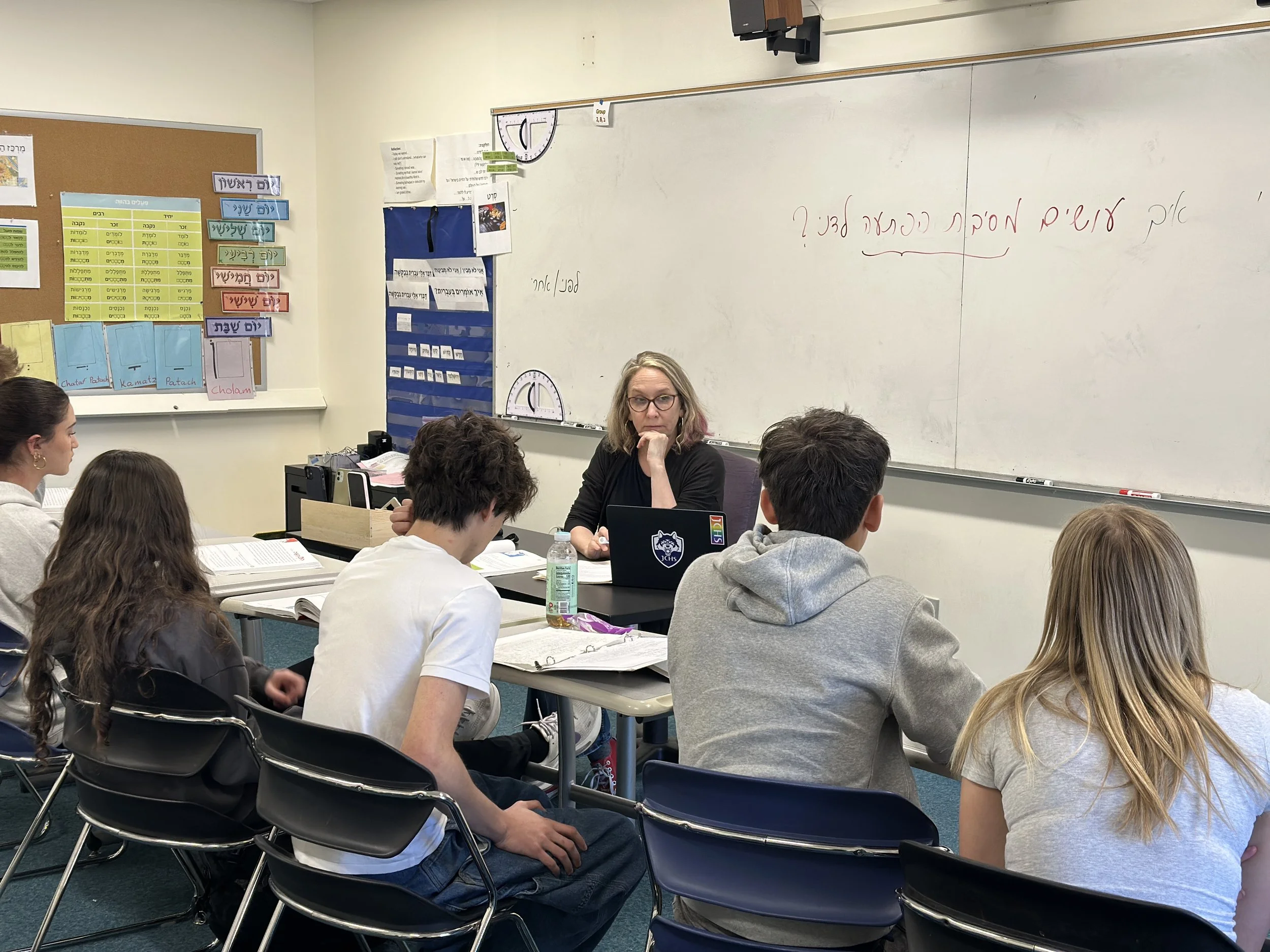
Hebrew courses immerse students in the language through conversation, reading, writing, music, media, and creative activities. As students progress, they strengthen their communication skills while developing a deeper connection to Hebrew language, Israeli culture, and Jewish life.
-
Open to: 9, 10, 11, 12
Prerequisite: Students are assigned to the correct level based on the Hebrew course matching assessment or their last Hebrew program text book.These courses introduce English-speaking students to Modern Hebrew and develop their proficiency in reading, listening, speaking, and writing. Our goal is to have each student achieve mastery of these skills as they explore the richness of the language that has kept Jews together for thousands of years. We teach Hebrew in Hebrew, so that students are immersed in the language for the duration of the whole class. Lessons include such class activities as listening to conversations and songs, watching TV-clips and short movies, role-playing, creative writing (skits, stories, greeting cards, and advertisements), oral presentations, guest speakers and debates.
Levels one through three are a general introduction to Hebrew grammar and basic vocabulary. In Hebrew I, students build their vocabulary and practice short dialogues from day one, as they learn the alphabet. In most of these levels, an extra teacher is present to support students with documented learning needs. This push-in model is designed to integrate the individual processing and learning needs of the students. Levels four through seven explore themes thoroughly and expand vocabulary and grammar within that theme.immersive classroom experience taught primarily in Hebrew. Activities include conversation, music, film and television clips, role-playing, creative writing, presentations, guest speakers, and debates.
Levels I–III build foundational grammar and vocabulary, progressing from learning the alphabet and basic conversation to increasingly sophisticated communication. Levels IV–VII explore themes in greater depth while expanding students' vocabulary, grammar, comprehension, and expressive skills.
Support is available within many introductory courses for students with documented learning needs through an integrated push-in model.
[Explore the Hebrew Curriculum]
-
Open to: 9 (by course matching assessment), 10, 11, 12
Prerequisite: Hebrew VIStudents explore contemporary Israeli literature while deepening their understanding of Hebrew language and culture. Through poetry, essays, short stories, and novels, students examine themes in modern Israeli writing and the influence of traditional Jewish texts—from the Bible and Talmud to later Jewish literature—on contemporary works.
-
Open to: 9 (by course matching assessment), 10, 11, 12
Prerequisite: Hebrew VIStudents advance their speaking, writing, reading, and listening comprehension through contemporary Israeli literature, media, discussion, and debate. Students interact with native Hebrew speakers and read novels selected to match their individual interests and reading levels, strengthening both language proficiency and their understanding of Israeli culture.
Spanish Language & Culture
Spanish courses emphasize communication from the very beginning, immersing students in the language while introducing the diverse cultures, histories, and experiences of the Spanish-speaking world. As students progress, they develop increasingly sophisticated speaking, listening, reading, and writing skills through authentic and engaging cultural experiences.
-
Open to: 9, 10, 11, 12
This course will teach Spanish the same way everyone learned their first language. Starting in the first week, we will communicate in Spanish, with content made understandable to students through context, body language, acting, pointing, drawing, or translating words into English from time to time. Students listen to and read messages in Spanish about their world and they compare it to the Spanish-speaking world and culture. For instance, they develop proficiency in speaking and writing in Spanish by learning about the December 31st running events in Latin America or the Bomba dancing of Puerto Rico. Following a similar methodology through the year, students will be able to communicate about themselves and the Spanish-speaking world and cultures in Spanish, using hundreds of words without hesitation. Toward the end of the course, we will also read our first short novel, Nueva escuela, nuevos amigos, which follows Antonio and his friend Adela as they navigate life at a new school. Through engaging in discussions of this novel in Spanish, students solidify their communicative skills.
-
Open to: 9 (by course matching assessment), 10, 11, 12
Prerequisite: Spanish ISpanish II expands students’ speaking, reading, writing, and listening skills. Students learn new vocabulary and grammar (particularly the past) through thematic units covering topics such as celebrations, health, and family. Videos, short books, multimedia cultural presentations, and interactive activities reinforce content and immerse students in Spanish-language cultures.
For instance, in the first unit about celebrations, students learn about Jewish holidays celebrated at JCHS in Spanish. They then expand on this knowledge base to learn about Day of the Dead by reading the short novel Papálotl, watching Coco in Spanish, and reflecting on similarities and differences between celebrations in the U.S. and in the Spanish-speaking world. The short novel La mola misteriosa, where a Colombian teen learns about her family’s past, provides a jumping-off point for discussions of the students’ families and cultural backgrounds in the unit about family. We end the year with a unit about travel, where students consider the positive and negative impacts of tourism in their own community and in Spanish-speaking communities. They will then use authentic Spanish-language sources to plan a trip to a country in the target language and culture.
-
Open to: 9 (by course matching assessment), 10, 11, 12
Prerequisite: Spanish IIIn Spanish III, students develop their skills through immersion in cultural contexts. In the first months of class, students take an imaginary trip to Guatemala to learn about Central American culture and history. By reading short novels such as Esperanza and studying the present tense, students learn to communicate ideas about Hispanic culture and to analyze characters' adventures. In the second part of the course, the book Frida immerses students in the sociocultural context of the famous artist Frida Kahlo, her life, and her work. By focusing on the past tense, students learn to express experiences in different forms of the past tense while expanding their understanding of other grammatical structures. Finally, students delve into the uses, representations, and larger cultural implications of coffee in a unit designed to increase communicative competence and cultural awareness in the Hispanic world. Overall, the class is supported by audiovisual materials and communicative skills are developed through conversational and written assignments.
-
Open to: 9 (by course matching assessment), 10, 11, 12
Prerequisite: Spanish IIIIn Spanish IV, students strengthen their ability to listen, read, write, and speak about complex topics in Spanish. Students start with an introductory unit where they delve into their own names, identities, and family histories. We then explore the history of Latines in the United States through biographies of Spanish-speakers in early California, a research project centered on Mexican land grants in the state, the short book Vidas impactantes, and a feature-length film, Bajo el mismo cielo. Students go on to explore Argentinian history through the lens of La guerra sucia, a novel, and the film Historia Oficial. Finally, students learn about the contemporary feminist movement in Mexico through short films, stories, artwork and selected poetry. These units allow students to grapple with Latin American and Spanish history and culture, while introducing them to grammatical structures (such as the subjunctive, the conditional, and the past perfect) needed for a more nuanced discussion of the topics.
-
Prerequisite: Spanish IV and Department Approval
In AP Spanish Language and Culture, students develop intermediate to advanced language skills through the study of real-life authentic materials such as articles, clips, podcasts, etc. These sources immerse students in the culture, politics, and current events of the Hispanic world, focusing on communities, identities, science and technology, and the arts, among other AP-relevant subjects. The communicative activities around these themes allow students to learn complex grammar structures, idiosyncratic expressions, and communicate complex ideas in essays, emails, conversations, and cultural presentations. In the last months of the course, students get acquainted with the exam format and learn to be comfortable with the complex communicative demands of the AP exam.
-
Prerequisite: AP Spanish Language and Culture
This course will introduce students to advanced cultural materials from the Spanish-speaking world. Through literature, film, art, and the development of academic projects, students will develop sophisticated language skills, while exploring and discussing the history and culture of the Hispanic world. In addition, students will strengthen their conversational skills and their grammatical accuracy through constant immersive contexts and relevant communicative situations.