
Science
Where Curiosity Leads to Discovery
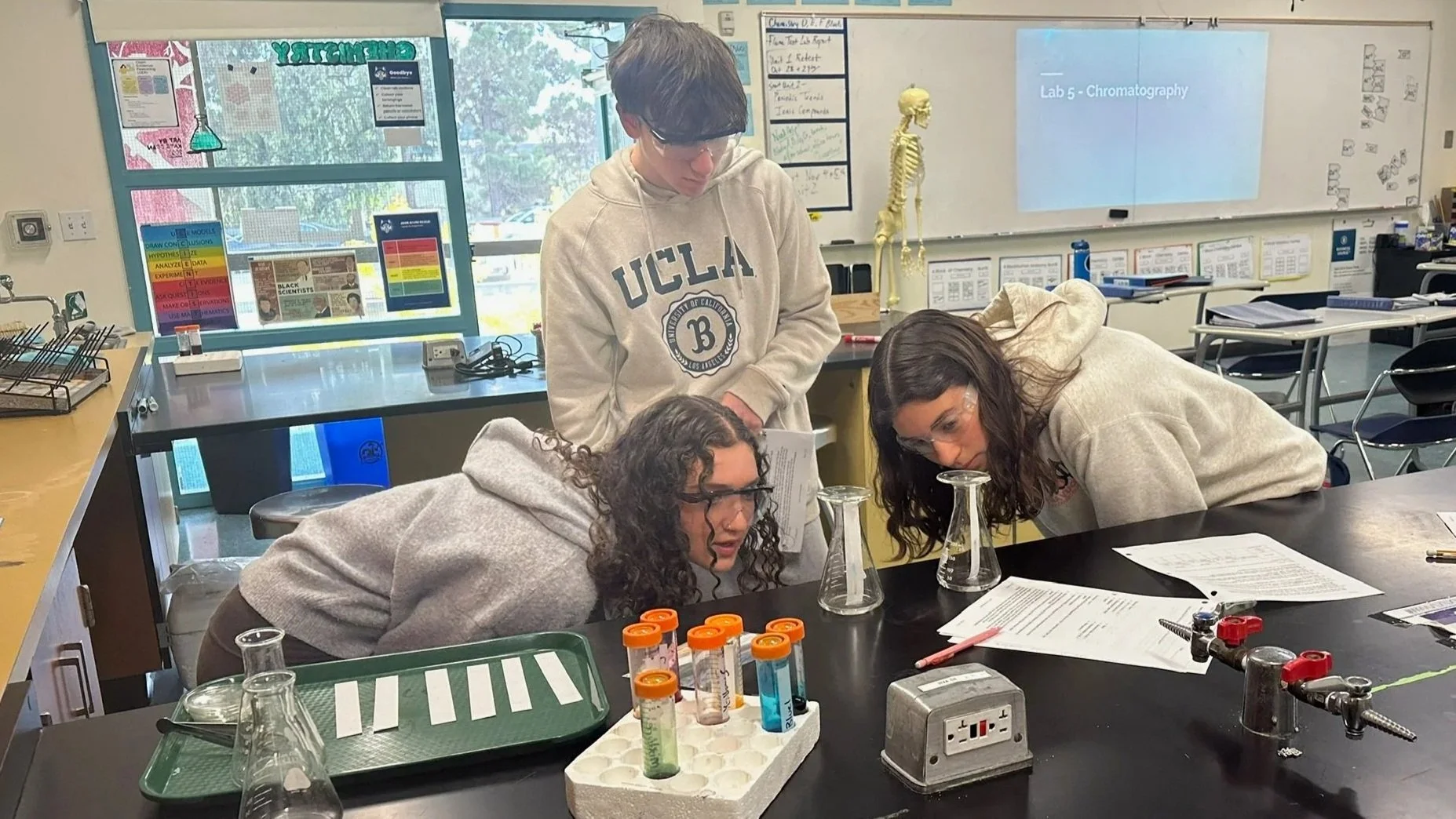
At JCHS, science begins with curiosity. Our inquiry-based program encourages students to ask questions, investigate the world around them, and develop the skills and confidence to pursue answers through experimentation and discovery.
Rather than simply memorizing scientific facts, students learn to think and work like scientists—making observations, developing and refining models, designing investigations, analyzing evidence, and using their findings to explain and predict natural phenomena.
As students progress through the program, they become increasingly independent thinkers, building a strong scientific foundation they can apply to advanced coursework and the world beyond the classroom.
Building Knowledge Across the Sciences
9th Grade
Conceptual Physics
Students begin by investigating the physical principles that explain how the world works, developing skills in experimentation, modeling, data analysis, and scientific reasoning.
10th Grade
Chemistry
Students build upon their understanding of physics as they explore matter, energy, atomic and molecular interactions, and chemical change through extensive laboratory investigation.
11th Grade
Biology
Students apply concepts from physics and chemistry to living systems, exploring cells, genetics, evolution, ecology, and the complex interactions that make life possible.
Science Requirements
Three Years of Core Lab Science
All JCHS students complete three years of core science: Conceptual Physics in ninth grade, Chemistry in tenth grade, and Biology in eleventh grade.
Students may then expand their studies through advanced and elective courses in biology, chemistry, physics, environmental science, computer science, engineering, anatomy, Earth science, and more.
Explore Science Courses
Beyond the three-year core sequence, students can pursue advanced coursework and electives that allow them to explore areas of science, technology, and engineering that match their interests and goals.
CORE COURSES
-
The Conceptual Physics course aims to have students discover physical laws themselves, and be able apply what they’ve learned to situations they encounter inside and outside of class. This course covers topics related to sound, light, motion, Newton’s laws, collisions, and electricity and magnetism. Lab work is the primary mode of instruction. Students make observations in lab, and use them to develop their own mental models of physical laws to describe how the world works. In addition to traditional problems, students are expected to write about physical concepts and apply what they have learned to real world situations. Laboratory skills themselves are a focus, including improving experiments and analyzing different types of data. Projects are also used to emphasize real world applications, including a musical instrument project where students use household objects and principles of both physical laws of sound and music theory to create playable instruments from coconut guitars to PVC pipe pan flutes.
-
Prerequisite(s): Conceptual Physics
Chemistry aims to develop students’ understanding of the particulate nature of matter, and of the changes in matter and energy that occur during physical and chemical reactions. We will build on many of the skills including using models, solving problems and investigating phenomena developed in Conceptual Physics. Topics that will be covered in this course include matter, atomic structure, the Periodic Table, chemical bonding and classification of solids, chemical reactions, stoichiometry, gasses, thermochemistry, phase changes, solutions, rates of chemical reactions, acids and bases, oxidation and reduction, and introductory organic chemistry. A strong emphasis will be placed on helping students to build investigation skills while completing 20+ experiments over the year.
Students interested in preparing for AP Chemistry will also study additional topics like molecular geometry of molecules with expanded octets, percent composition, and weak acid/base models.
-
Prerequisite(s): Chemistry
Biology is a college preparatory lab course. It aims to develop students’ understanding of the fundamental characteristics of life at both the cellular and organismal levels. This course will build on students’ understanding of physics and chemistry as we explore the science of living things. Through an exploration of biochemistry, cells, and genetics, students learn how molecules and energy combine to form and direct all life, and apply these lessons to the study of the human reproductive system. As the class studies evolution, students learn how the logical consequences of differential survival and inherited traits produce the vast diversity of species. We conclude the year with the study of ecology, investigating the complexities of species’ interactions in Serengeti National Park.
This course focuses heavily on building advanced science skills. Students will design investigations, build explanations based on evidence and create models to explain and predict phenomena. In a cross-curricular project with the humanities department, students dive into the science and ethics of gene editing technologies to synthesize an argument that addresses questions like, “When, if ever, would it be ethical to edit the human genome?”
ELECTIVE COURSES
-
Prerequisite(s): Algebra II, Chemistry, and a B+ in Biology
Biology is the study of living organisms and systems. How does evolution drive the unity and diversity of life? How do biological systems use energy and molecular building blocks to grow, reproduce, and maintain dynamic homeostasis? How do living systems store, retrieve, transmit, and respond to information essential to life processes? How do biological systems interact, and these systems and their interactions exhibit complex properties? AP Biology is equivalent to a college-level introductory biology class in which students develop the scientific skills and practices necessary to interpret biological data and evaluate evidence. Topics include evolution, cellular processes, energy and communication, genetics, information transfer, ecology, and interactions. Inquiry-based learning and laboratory work are central to this course. Students perform and report on laboratory investigations of enzyme activity, osmosis and diffusion, cell division, bacterial transformation, and transpiration in plants, among other topics. Students also complete a summer assignment to read, analyze, and review a popular biology book of their choice. Please note that AP Biology is a quantitative course. Although neither Statistics nor Pre-Calculus are co-requisite, students not concurrently enrolled in one of these or a higher-level math class should anticipate some additional math work outside of class time.
Please Note: AP courses may require additional meeting times throughout the year.
-
Prerequisite(s): Precalculus (or concurrent enrollment in Precalculus) and a B+ in Chemistry
Chemistry is the study of the relationship between submicroscopic atomic/molecular structure and the macroscopic (observable) properties of matter. How do quantities at the atomic and macroscopic scale relate to one another within across scales? How do properties observable at the macroscopic level emerge from atomic and molecular structures? How do these quantities and properties change and rearrange during chemical reactions? How do energy distributions change during chemical reactions, and even drive the reaction itself? AP Chemistry is equivalent to a college-level general chemistry class in which students develop the scientific skills and practices necessary to analyze chemical data and evaluate evidence. Topics include atomic structure, intermolecular forces and bonding, chemical reactions, kinetics, thermodynamics, and equilibrium. Inquiry-based learning and laboratory work are central to this course. Students perform and report on laboratory investigations of chromatography, gravimetric analysis, spectroscopy, rate laws, equilibrium systems, and titrations, among other topics. Students also complete a summer assignment reviewing stoichiometry and other foundational topics from tenth grade chemistry so that we can hit the ground running in the fall. AP Chemistry is a heavily quantitative course. In May and June (after the AP exam), 11th graders in the class will work on one or more fun, chemistry-related topics outside the scope of the AP curriculum.
Please Note: AP courses may require additional meeting times throughout the year.
-
Open to: 10, 11, 12
Prerequisite(s): Algebra IThis AP Computer Science course offers an in depth exploration of object oriented programming, with a strong emphasis on Java language fundamentals including programming basics, syntax, and program structure. Students focus on algorithm development and software design, using control structures such as loops and conditional statements to solve increasingly complex problems. A significant portion of the curriculum is dedicated to working with data structures including arrays, array lists, and two dimensional arrays, as well as using Java’s standard libraries to complete common programming tasks such as reading and processing data from files.
Students regularly analyze problems, write and test code, and refine their solutions using sound computational thinking practices. Learning culminates in a final project in which students design and implement a Battleship game that integrates object oriented design, algorithms, and control logic. Students do not need prior programming experience to succeed in this course, particularly if they have strong problem solving skills, though many choose to take AP Computer Science Principles first.
Please Note: a laptop with a full operating system and local storage (hard drive) is required. Chromebooks or similar devices are not suitable for this course.
AP courses may require additional meeting times throughout the year.
-
Open to: 10, 11, 12
Prerequisite(s): Algebra IThis AP Computer Science course offers a multidisciplinary approach to computer science, using coursework developed at UC Berkeley. The course’s rigorous and rich curriculum aims to broaden participation in computer science, while maintaining a strong foundation in theory. Students code in Snap!, a language that’s easy to use, yet offers powerful high-level tools. Major ideas include abstraction, control structures, list processing, data science, networking, security, digital literacy, and seminar-style debate and free writing on current events, ethics, and the impact of technology on society. AP CSP students submit a portfolio-style independent programming project to the College Board in addition to sitting a multiple choice exam.
This is an introductory course. Students do not need prior programming experience, or math experience beyond Algebra I.
Please Note: AP courses may require additional meeting times throughout the year.
-
Prerequisite(s): Conceptual Physics, Chemistry, and a B+ in Biology
AP Environmental Science is the study of the natural world and human interactions within it. The course is interdisciplinary, building on concepts in physics, chemistry, biology, earth science, and mathematics. The general scope of the course is investigating how the earth works, how living things interact on earth, the impacts that humans have on their environment, and the choices available to humans today regarding how we will treat our environment in the future. Students grapple with questions such as: How many people can the planet support? How do our energy needs and our use of fossil fuels impact life on earth? And how can we produce and use energy more sustainably?
The course includes hands-on activities, labs and environmental monitoring investigations. Specifically, students collect and assess air, soil and water samples, appraise and calculate the value of trees and build skill in the application of appropriate mathematical relationships to assess and solve problems.
Please Note: AP courses may require additional meeting times throughout the year.
-
Prerequisite(s): Conceptual Physics, AP Calculus AB or BC (or concurrent enrollment in AP Calculus AB or BC)
This deep and narrow course in Newtonian Mechanics covers kinematics, dynamics, momentum, energy, projectile motion, rotation, oscillation, and gravitation. The course is focused on exploring natural physical phenomena and solving problems, especially those involving calculus. It is designed to contain the same course material as the typical calculus-based introductory physics course and laboratory program offered at many colleges and universities. Students examine many real world problems that would otherwise be too difficult to solve by other means. Laboratory skills are also a focus, with an emphasis on student-led experimental design, and data analysis techniques such as linear regression and error propagation.
Please Note: AP courses may require additional meeting times throughout the year.
-
Open to: 12
Prerequisite(s): Biology and ChemistryThis is a lab-based course in which students investigate the structure and function of the human body, learning how their own bodies work and in developing “body literacy” that will serve them throughout their lives. Body systems studied will vary based on student interest but may include the nervous system, the musculoskeletal system, the cardiovascular system, the respiratory system, the endocrine system, the urinary system, the digestive system, the immune system, and the male and female reproductive systems. Dissections may feature heavily in the lab portion of this class, so students should consider their comfort with that when enrolling. Students will conclude the year by investigating the physiology of a particular disease of interest as well as the medical and social implications of this disease. This is an ideal course for students interested in pursuing a clinical health career such as medicine, nursing, dentistry, pharmacy, or physical therapy.
-
Open to: Grades 10–12
Prerequisite: Algebra IDesigned for the innovative and curious, this class centers around the First Technology Challenge (FTC), in which students design, build, and code robots that compete head to head against those of other teams. Students work collaboratively in overlapping roles as builders and programmers. Builders bring designs to life using tools such as 3D printers, laser cutters, and OnShape CAD, constructing robots with mechanisms like intakes, shooters, and drivetrains. Programmers use Android Studio and Java to control robot behavior, writing code for autonomous movement, sensor feedback, and gamepad operation. Throughout the season, students iterate on designs, test ideas, and refine both hardware and software solutions in response to real engineering constraints.
In addition to robotics design, the course emphasizes the use of mathematics and data to model and analyze physical systems. Students learn in class how to collect experimental data, use Excel spreadsheets, perform regression analysis, and apply dimensional analysis to understand scaling and functional relationships. As a culminating project, students design and carry out an investigation such as measuring the time required for water to drain from bottles of different volumes, developing and testing mathematical models using their own data. No prior programming or engineering experience is required to take this course, as all necessary skills are introduced and practiced throughout the year. Students with prior experience are encouraged to take on more advanced or extended challenges within the same projects.
Where Rigor Meets Wonder
Hear from Dr. Cecily Burrill, Dean of Math & Science, about JCHS's approach to scientific learning—from Conceptual Physics to CRISPR and the curiosity that drives discovery.